Most supplier pages list the same eight reasons PET works for drinks: light, tough, good barrier, recyclable, cheap, flexible, chemically resistant, convenient. All eight are directionally true, and all eight are also used to sell formats that fail on the filling line. The useful version of that list sorts the claims by the conditions under which each one holds. That is what this page does.
A plastic soda can is the right test case, because carbonated drinks are the harshest routine demand you can put on a PET container. Carbon dioxide wants out, oxygen wants in, and the container has to survive internal pressure at the same time. If the format holds up there, it will hold up for juice, tea and dairy too.
Where the Claims Hold and Where They Break
Here is the full list with a verdict attached, before the detail:
| Claim | Verdict | The condition that decides it |
|---|---|---|
| Lightweight | True against glass, false against aluminium | A formed PET can is heavier than the aluminium can it replaces; preforms shipped flat are what save freight |
| Break-resistant | Holds | No glass shatter risk in transit or handling |
| Good barrier | Holds for CO2, limited for O2 | Carbonation retention is engineered through wall gauge and closure; oxygen-sensitive products need a shelf-life plan |
| Recyclable | Holds, with a design caveat | Single-material body and aluminium end separate cleanly; the sleeve must be wash-off or floatable |
| Lower cost | True at small and mid volume | Above a certain annual volume the aluminium can line wins on unit cost |
| Design flexibility | Holds, gated by tooling | Shape freedom is real; a new mould is the entry cost |
| Chemical resistance | Holds for acid and low alcohol | Terpene flavour systems need an assessment before the mould is cut |
| Convenience | Holds | Cylindrical grip, stackable, single-hand pour |
Four of those rows carry the whole decision. The rest are true enough to leave alone.
Lightweight: True Against Glass, Misleading Against Aluminium
The comparison that matters is the one nobody prints. A 500 ml glass bottle typically weighs somewhere north of 300 g. A PET can in the same format sits in the 20 to 30 g band depending on wall gauge. That is an order of magnitude, and it shows up directly in pallet count, freight class and the cost of moving empty containers to a filler.
Against aluminium the claim inverts. A 500 ml aluminium can weighs around 13 to 15 g, so a formed PET can is the heavier object, not the lighter one. Any supplier claiming PET beats metal on container weight is comparing the wrong things.
The honest advantage is upstream of the container. PET ships as preforms, which nest and stack, so a filler can hold weeks of production in a fraction of the warehouse volume that formed cans demand and blow close to the filling date. On export lanes that difference is often larger than the gram gap on the finished unit, because you are moving resin geometry rather than air. The 150–1000 ml beverage can range is built around exactly that model. When we quote a 500 ml programme, our freight comparison covers preforms landed and blown at destination, not the weight of the finished can — because that is the number the buyer actually pays.
Barrier: What a Plastic Soda Can Keeps and What It Loses
This is where the format earns or loses the account, and where most marketing copy stops being useful.
Carbon dioxide retention is achievable, but it is engineered rather than given. Three variables decide it: wall gauge in the body, the integrity of the double seam or closure, and the headspace pressure set at filling. Tighten those and a plastic soda can hold carbonation through normal ambient distribution. Loosen any one of them and the same container goes flat in weeks. Standard practice is to design the shelf life first, then specify the gauge that delivers it, not the other way round.
Oxygen is the harder direction. PET transmits oxygen at a rate that glass and aluminium do not, and no wall gauge fixes that completely. For carbonated soft drinks this barely matters, because the product is already acidic, coloured and short-lived on shelf. For juice, cold-brew coffee and dairy drinks it matters a great deal: ascorbic acid oxidises, colours shift brown, and dairy fats develop off-notes. Those products run on shorter coded life, on oxygen scavengers, or on a barrier layer, and a supplier who does not raise this on the first call has not run the category.
The practical takeaway: treat the barrier claim as product-specific. Ask what coded shelf life the format has been validated for with your product, at your fill temperature, with your closure. A number without those three inputs is a guess. In our own filling trials we validate against the customer’s product and closure, not a generic carbonated reference, because a juice at pH 3.2 and a cola at pH 2.5 age very differently in the same body.
Clarity and Design: The Commercial Half of the Material
Transparency is usually filed under aesthetics. It is better understood as a shelf mechanic. A clear body lets the liquid itself become the graphic, which is why the format keeps winning in iced tea, cold brew, sparkling juice and Functional drinks where colour is part of the promise. The clear can body also removes the need for a full-wrap opaque print to carry the product story.
Shape freedom is genuine across the soda can range: straight-wall, tapered, bulbous and squat profiles all run in the same plant, and a 360-degree shrink sleeve covers the full body including the shoulder. Metallic and mirror effects are achievable because the sleeve sits outside the container, not in contact with the drink.
The gate is tooling, not physics. A new profile means a new mould and a new blow programme, and that cost has to be amortised over the order. For a launch of 200 pieces this is why standard profiles make sense; for a brand with a two-year horizon, the mould is the cheapest part of the programme.
Temperature and Chemistry: The Two Hard Limits
Two constraints cause more failed projects than every other factor combined, and both are routinely omitted from the sales sheet.
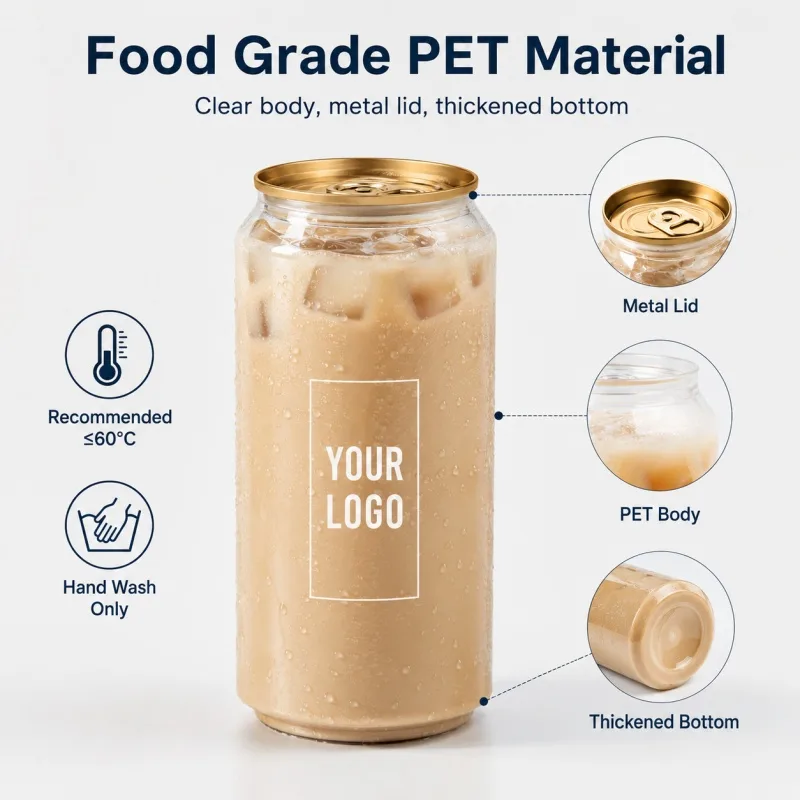
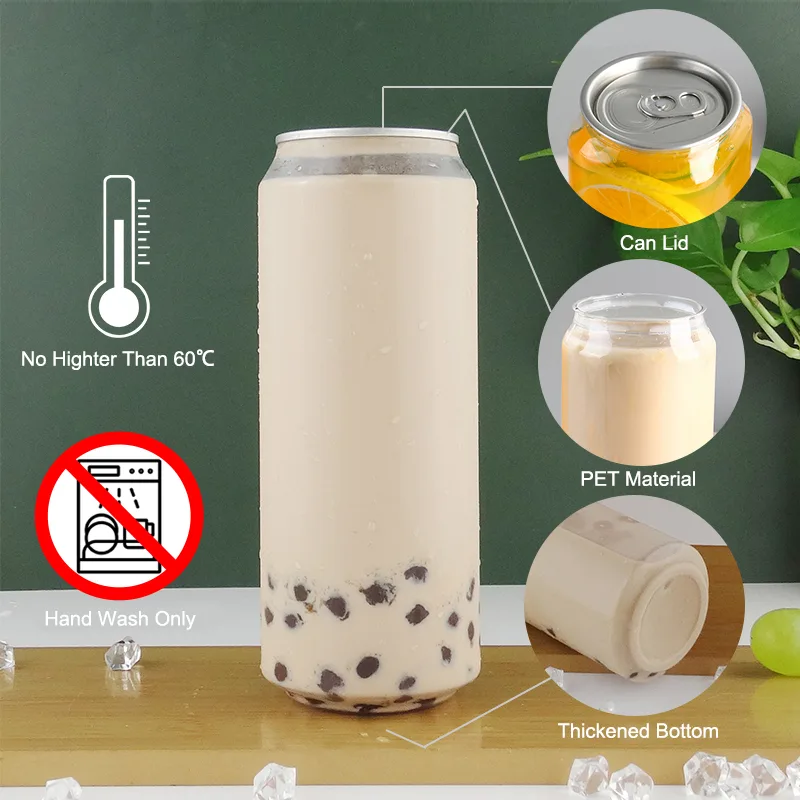
Temperature. Our standard cans are rated -30°C to 60°C. That covers cold fill, aseptic fill, chilled distribution, frozen desserts and ambient retail. It does not cover hot fill at 85°C. PET softens and shrinks in that range, and no sleeve or closure specification changes it. If the process is hot fill, the correct answer is heat-set PET in a bottle format or a different material entirely.
| Fill process | Runs in our standard cans | What to plan for |
|---|---|---|
| Cold fill, ambient or chilled | Yes | Baseline case; shelf life set by wall gauge and closure |
| Aseptic fill | Yes | Sterility sits with the filler, not the container |
| Carbonated, 2.5–3.5 vol CO2 | Yes | Headspace pressure and seam integrity decide retention |
| Hot fill at 85°C | No | Heat-set PET in a bottle format, or a different material |
| Retort sterilisation | No | Aluminium or retort pouch |
Chemistry. PET handles the acid load of carbonated drinks, juices and teas without trouble, and it tolerates low-alcohol filling. The exception worth knowing is terpene-based flavour systems. Citrus oils and similar concentrates can initiate environmental stress cracking in PET under load, and the failure appears as hairline cracks at the base or the shoulder weeks after filling. It is not a reason to avoid the format, it is a reason to declare the flavour system before the mould is cut so the wall gauge and resin grade can be specified for it. We now ask for the flavour system in writing at quoting stage for exactly this reason.
Cost: When a Plastic Soda Can Beats Aluminium
The cost claim is the most context-dependent item on the list, and it flips with volume.
A plastic beverage can wins in the zone where a brand runs several SKUs, changes artwork often, and cannot justify a container load of printed empties. Preforms are common across sizes, sleeves are applied after filling, and a label refresh does not strand inventory. MOQ at 200 pieces means a market test is possible without committing to a production run, and lead time of 15–25 days keeps a launch on schedule.
The aluminium can wins on the other side of the line. Its forming and filling speeds are far higher, its unit cost at high volume is lower, and for a single evergreen SKU in the millions the economics are not close. Choosing PET for a product that has already proven itself at that scale is a mistake, and we say so when the numbers point that way.
Which Drinks Fit the Format
Fits comfortably: carbonated soft drinks, sparkling water, cold brew and RTD coffee, iced tea, juice and juice drinks, functional and energy beverages, dairy drinks under chilled distribution, dessert and solid-fill products.
Fits with a shelf-life plan: oxygen-sensitive juice, dairy with high fat content, anything with a long ambient code date. The format works, the validation work is on the product side.
Does not fit: hot-fill at 85°C, retort-sterilised products, and anything requiring a multi-year ambient shelf life without a barrier layer. For those, aluminium remains correct.
On Our Line
We mould PET cans at 202 finish from 150 to 1000 ml, seal them with aluminium easy-open ends or PP lids, and quote body and decoration as one specification so print and container are approved together. Standard sizes start at 200 pieces, lead time runs 15–25 days, and every order ships after a pre-production sample is signed off.
Send the fill volume, the process temperature, the target shelf life and the closure you need. We will tell you whether the format holds. If it does not, that is a shorter conversation than a failed launch.
Key Takeaways
- The eight standard claims are all directionally true; four of them decide the project and the rest follow.
- A formed PET can is heavier than the aluminium can it replaces. The freight saving comes from shipping nested preforms, not from the finished unit.
- Carbon dioxide retention is engineered through wall gauge, seam integrity and headspace; it is not a property of the resin alone.
- Oxygen is the real limit. Juice, coffee and dairy need a coded shelf life validated for the format, not a generic claim.
- Standard cans run -30°C to 60°C. Hot fill at 85°C is out of scope.
- Terpene flavour systems should be declared before tooling, because citrus oils can stress-crack PET under load.
- Cost advantage flips with volume: PET wins on multi-SKU, short-run and fast-launch programmes; aluminium wins in the millions.
References
- Commission Regulation (EU) No 10/2011 on plastic materials and articles intended to come into contact with food — https://eur-lex.europa.eu/eli/reg/2011/10/oj
- 21 CFR 177.1630, Polyethylene phthalate polymers — https://www.ecfr.gov/current/title-21/section-177.1630
- Commission Regulation (EU) 2022/1616 on recycled plastic food contact materials — https://eur-lex.europa.eu/eli/reg/2022/1616/oj